If there’s one question I get asked more than almost any other, it’s this: “Where did Lean come from?”
People usually ask because they know I spent years working at Toyota. They assume Lean was something Toyota created, named, and taught internally.
The answer is more nuanced than that.
It helps you identify the eight common types of operational waste that reduce efficiency and create unnecessary complexity.
Toyota developed the management system that inspired what the world now calls Lean manufacturing, but while I was there, I never heard anyone say, “Let’s do Lean.”
Instead, we talked about solving problems. We studied how work flowed. We practiced PDCA. We developed people. We standardized work so we could improve it tomorrow. The word Lean came later.
Understanding the origin of Lean manufacturing is more than an interesting piece of history. It helps explain why so many organizations struggle to implement Lean today. They adopt the label without understanding the management philosophy behind it.
What Is the Origin of Lean Manufacturing?
The origin of Lean manufacturing begins in Japan after World War II. Unlike American automakers that benefited from great domestic demand and economies of scale, Toyota faced severe resource constraints. Materials were scarce, production volumes were low, and the company simply couldn’t afford the waste that traditional mass production tolerated.
Instead of trying to copy Ford’s assembly lines, Toyota developed a different approach. Leaders like
Eiji Toyoda and engineer
Taiichi Ohno began designing a production system that focused on delivering customer value while eliminating activities that didn’t contribute to it. Over time, this became known internally as the
Toyota Production System (TPS).
TPS wasn’t built overnight.
It evolved through decades of observation, experimentation, and continuous improvement. Rather than relying on large batches, excess inventory, or rigid planning, Toyota built a system that encouraged teams to identify problems, solve them quickly, and continuously improve how work was performed.
Today, these principles are recognized around the world as the foundation of Lean manufacturing.
Who Coined the Term “Lean”?
One of the biggest misconceptions is that Toyota invented the word Lean. It didn’t.
The term was introduced by researchers from MIT’s International Motor Vehicle Program (IMVP), who spent years studying automotive manufacturers around the world.
Their findings were published in the landmark 1990 book The Machine That Changed the World by James P. Womack, Daniel T. Jones, and Daniel Roos. The researchers used the word Lean to describe Toyota’s ability to produce higher quality products while using fewer resources than traditional mass production systems.
In other words, Lean was a description—not Toyota’s name for its own system. That distinction is important because it changes how we think about Lean today.
Did Toyota Invent Lean Manufacturing?
The answer depends on what you mean. Toyota invented the Toyota Production System. MIT researchers later introduced the term Lean manufacturing to describe what they observed inside Toyota.
Although the two are closely related, they aren’t exactly the same.
Toyota wasn’t trying to create a methodology that businesses around the world would eventually adopt. It was trying to solve practical operational problems.
How do we produce high quality with limited resources?
How do we reduce defects?
How do we make problems visible?
How do we develop employees so they become better problem solvers?
Those questions shaped the Toyota Production System long before anyone called it Lean.
Why Toyota Never Called It Lean
This is probably the biggest takeaway from my own experience. When I worked at Toyota, conversations weren’t centered around Lean initiatives or Lean transformations.
Instead, they sounded like this:
- What’s the current condition?
- Where is the bottleneck?
- Why did this problem occur?
- What countermeasure should we test?
- What did we learn?
The emphasis was always on improving the work—not implementing a methodology. That’s why I often tell leaders that Lean isn’t something you install. It’s something you practice. The tools matter, but the mindset matters more.
Lean Manufacturing vs. the Toyota Production System
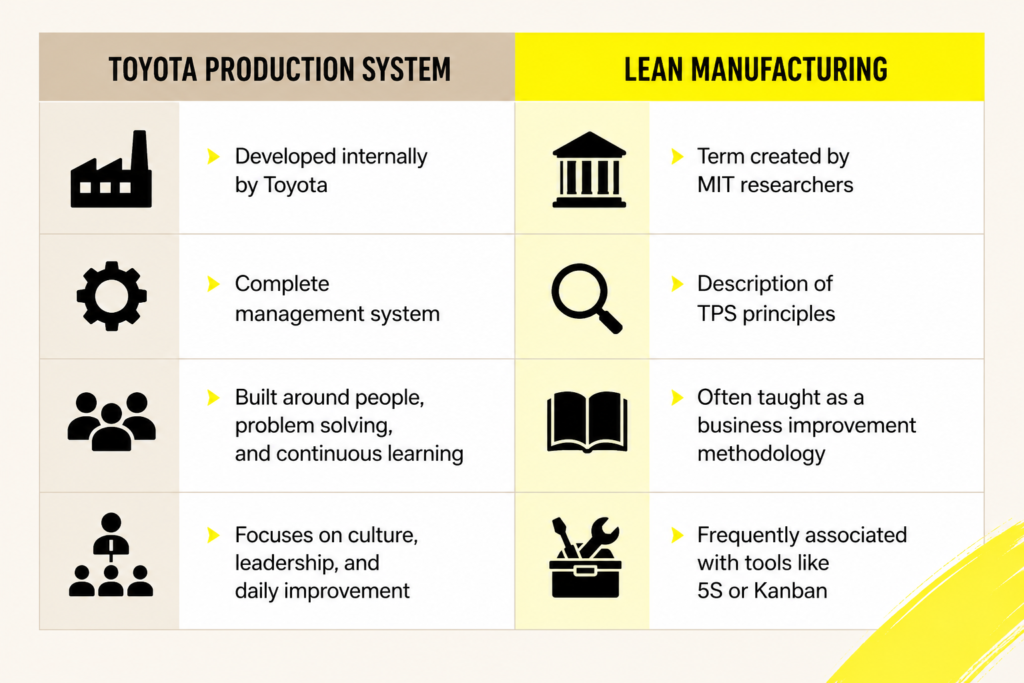
This distinction explains why some Lean initiatives produce lasting results while others fade after a few months.
Many organizations adopt the visible tools but overlook the management system that made those tools effective in the first place.
Why the Origin of Lean Manufacturing Still Matters
At first glance, the history might seem academic. It isn’t. The origin of Lean manufacturing explains one of the biggest mistakes organizations still make today.
Many companies approach Lean as a project. Toyota approached improvement as part of everyday work. That’s a very different mindset.
Instead of asking, “How do we implement Lean?” Toyota asked, “How do we improve this process today?”
That shift changes how leaders think about operations. Rather than chasing the latest framework, they begin building systems that make improvement part of the organization’s daily routine.
Common Misconceptions About Lean Manufacturing
Lean is about cutting costs.
Reducing costs is often a result of Lean—not its purpose. The real objective is to create more value for customers by eliminating activities that don’t contribute to that value.
Lean only applies to manufacturing.
Although Lean originated in manufacturing, its principles apply anywhere work moves through a repeatable process.
I’ve used these same concepts with law firms, consulting companies, educational organizations, and other service businesses. The work looks different, but the challenges are remarkably similar: communication breakdowns, inconsistent execution, unclear ownership, and unnecessary complexity.
Lean is just a collection of tools.
Tools like 5S, Kanban, value stream mapping, and visual management are valuable. But tools alone don’t create operational excellence. Without disciplined leadership, clear standards, and continuous learning, those tools become isolated projects rather than
sustainable ways of working.
The Role of PDCA in Lean
If I had to identify the discipline that sits underneath Lean, it would be PDCA:
Plan, Do, Check, Act. PDCA provides a structured way to improve work without jumping straight to solutions.
Instead of making assumptions, teams first understand the current condition. They test a countermeasure, measure the results, and adjust based on what they learn.
What Today’s Organizations Can Learn
The business environment has changed dramatically since Toyota began developing the Toyota Production System.
Organizations now have access to advanced software, automation, artificial intelligence, and more operational data than ever before.
Yet many companies continue to struggle with the same problems Toyota was trying to solve decades ago:
- Poor visibility into how work flows.
- Inconsistent processes.
- Communication breakdowns between departments.
- Reactive decision-making.
- Continuous firefighting.
Technology doesn’t eliminate these problems. In many cases, it magnifies them.
That’s why understanding the origin of Lean manufacturing remains so relevant today. The underlying principles—clarity, standardization,
continuous improvement, and respect for people—are just as valuable in a service business as they were on a factory floor.
Frequently Asked Questions
Who invented Lean manufacturing?
Toyota developed the Toyota Production System, but the term Lean manufacturing was coined by researchers at MIT who studied Toyota’s production methods.
Why is it called Lean?
The word “Lean” was chosen because Toyota consistently achieved better results while using fewer resources than traditional mass production systems.
Is Lean the same as the Toyota Production System?
No. The Toyota Production System is Toyota’s original management system. Lean is the name later given to many of the principles found within that system.
Is Lean only for manufacturing?
No. Lean principles have been successfully applied in healthcare, financial services, government, education, software development, professional services, and many other industries.
What is the biggest misconception about Lean?
Many organizations believe Lean is a collection of tools designed to reduce costs. In reality, Lean is a management philosophy focused on developing people, improving processes, and continuously solving problems
Why Lean Continues to Influence Organizations Worldwide
Lean isn’t simply a historical concept. Its influence continues to grow across industries.
According to the
Lean Enterprise Institute,
The Machine That Changed the World introduced Lean thinking to a global audience after researchers spent
five years studying the worldwide automotive industry, fundamentally changing how organizations approached operations and continuous improvement.
Research also continues to demonstrate the financial impact of operational inefficiencies. The
American Society for Quality (ASQ) estimates that the
Cost of Poor Quality (COPQ) can account for
15% to 20% of sales revenue in many organizations, illustrating why systematic problem-solving and process improvement remain critical for long-term competitiveness.
The story behind the origin of Lean manufacturing reminds us that Toyota never set out to create a globally recognized methodology.
It set out to build a better way of working. The label came later. The discipline came first.
That’s the lesson I hope more organizations take away. Whether you call it Lean, the Toyota Production System, or operational excellence, sustainable improvement doesn’t come from adopting a new set of tools. It comes from building a culture where people can see problems, solve them together, and improve the work every day.
Want to Work With Us?
Most organizations don’t need another framework. They need a better way to execute.
The Ops Edge Academy gives operations leaders the tools and coaching to improve processes, lead change with confidence, and build systems that continue improving long after the program ends.
Applications for the Fall 2026 cohort close July 31. Only 10 seats are available.
















One Response