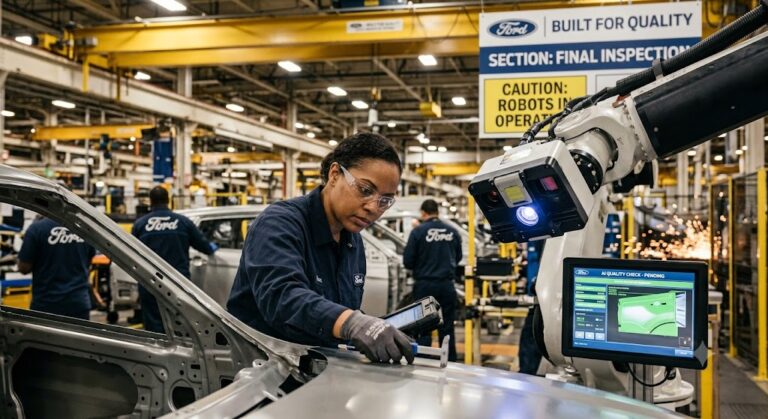
A recent Bloomberg article shared that Ford has been rehiring quality inspectors after AI fell short in replacing some of their work.
I think this is one of the most important operational lessons companies can pay attention to right now. Not because AI failed.
If AI is on your radar, I also wanted to share the Top 10 AI Starter Projects—a practical guide to identifying the best places to start, focusing on processes that are already repeatable and ready to scale. Download your free copy here
Now, here’s the real lesson.
AI cannot replace operational judgment, clear standards, or process expertise that has been built through years of experience.
They look at AI and think, Great. This will help us move faster. And it can. But speed is only valuable when the underlying process is strong. If the process is unclear, AI does not magically fix it. It simply helps the business move faster through the same confusion. That means faster mistakes.
Faster rework.
Faster miscommunication.
Faster quality issues.
Faster decisions made without the right context.
AI is an accelerator. But what it accelerates depends entirely on the system underneath it.
The Real Problems Usually Aren’t Technology Problems
Inside growing companies, the real operational problems are rarely as simple as “we need better technology.”
More often, they look like this:
- Work lives inside people’s heads.
- Handoffs are inconsistent.
- Managers make decisions differently.
- Teams do not share the same definition of “done.”
- Quality standards are assumed instead of documented.
- People know when something feels wrong, but the process does not make that problem visible early enough.
That is where breakdowns happen. Not because people are lazy. Not because teams do not care. Not because leaders are not trying hard enough. Usually, the system has outgrown the informal ways of working that got the company to this point.
Why Experience Still Matters
A great quality inspector is not just checking a box. They are seeing patterns. They are noticing variation. They are catching what does not look right before it turns into a bigger problem. They are using judgment that comes from repetition, standards, context, and experience. That kind of knowledge is incredibly valuable. But it is also risky if it only lives in one person’s head.
The goal should not be to replace that expertise with AI. The goal should be to capture, clarify, and strengthen that expertise so the entire organization can benefit from it.
What Real Process Improvement Looks Like
That is what real process improvement does. It makes the invisible visible. It turns tribal knowledge into shared knowledge. It creates a common way of working.
It helps teams identify where variation is happening and why. It gives managers the structure to improve the process instead of constantly reacting to symptoms. And once that foundation is strong, AI can become incredibly powerful.
But AI needs something to work from.
It needs:
- Clear inputs.
- Clear standards.
- Clear ownership.
- Clear decision rules.
- Clear escalation paths.
- Clear definitions of quality.
Without those things, AI becomes another layer on top of an already messy system.
As we all know, adding fancy technology to a messy process is a little like putting a chandelier in a garage. It may look impressive, but the oil stains are still there.
The Companies That Will Win
The companies that will win over the next few years will not be the ones that rush to automate everything first.
They will be the ones that build the operational foundation that makes automation useful.
They will invest in people who understand how work actually flows. They will teach managers how to see waste, reduce variation, improve handoffs, and solve root-cause problems.
They will stop treating process improvement as a side project and start treating it as a leadership capability.
That is exactly why I created The Ops Edge Academy.
The Ops Edge Academy is a 12-week process improvement certification for operators, managers, and internal leaders who need to make work clearer, more consistent, and easier to scale.
Participants learn how to map the current state, identify bottlenecks, prioritize the right problems, create countermeasures, and lead improvement inside the business.
Because before AI can scale your company, your process has to be worth scaling.
Our next cohort starts this fall, and seats are limited.
If you have an internal leader who needs this capability—or if you know your company is growing faster than your processes can support—this is the time to build that foundation.
Learn more about the Ops Edge Academy here