

In the first week of September, industry insiders were warning that AI could pose an existential threat.
At the same time, another conversation was gaining momentum: Should we deliberately slow it down?
Anthropic CEO Dario Amodei has argued for “pacing the frontier,” raising a bigger question about whether AI capabilities are advancing faster than our ability to manage what comes with them.
It’s an interesting shift after years of racing to make AI faster, smarter, and more capable.
But there’s a lesson here for business leaders, too.
Moving faster with AI isn’t necessarily the same as being ready for AI.
If you’re a non-technical company and deciding where AI could actually make a difference in your organization, I created Top 10 Recommended First AI Projects to help you identify practical places to start.
Because while the AI industry debates how quickly the technology itself should advance, companies have another question to answer:
Is the business underneath it ready for what comes next?
That starts with understanding how your processes, information, and systems actually connect.
Why Business Systems Integration Should Come Before AI
When we map a business process, we typically ask two questions: What happens, and who does it?
As companies prepare for AI, I believe there is a third question we need to add: What system holds the information required to make that step happen?
That might sound like an IT question, but it is increasingly an operations question.
I recently had a conversation with a business leader who raised this exact issue.
As his company thinks about its future technology infrastructure, he wants to understand not only how work moves across the organization but also which information systems and data sources support each step.
That distinction matters. If you eventually want AI to work across your business, understanding the process alone isn’t enough. You also need to understand how the information supporting that process moves.
That is where business systems integration becomes critical.
Your Systems Can Work Individually and Still Fail Collectively
Most growing companies don’t have one system running the entire business. They have a CRM for sales, an accounting or ERP platform for finance, a project management system for operations, a customer service platform, shared drives, spreadsheets, email, messaging platforms, and an expanding collection of specialized tools.
Each system may work perfectly well on its own.
The problem becomes visible when you follow a customer, project, order, or decision across the organization.
Information gets exported from one system and uploaded into another. Someone copies data from the CRM into a spreadsheet. A critical detail gets communicated in Slack but never makes it into the project management system. A customer request is documented in one place while the team responsible for delivering it works somewhere else.
Nothing appears completely broken, but the information isn’t moving as one connected system.
And the scale of this problem is significant. MuleSoft’s 2026 Connectivity Benchmark Report, based on a survey of 1,050 IT leaders globally, found that the average organization now manages 957 applications, but only 27% of them are connected.
This isn’t simply a technology problem. It is an operational one.
That idea also stood out to me while reading Christine Pearsall’s Connected Before Intelligent. Pearsall writes specifically about medical device manufacturing, where systems responsible for product lifecycle management, quality, manufacturing, and enterprise planning may each perform their intended functions while remaining disconnected from one another. The gaps between those systems create manual handoffs, duplicated work, and fragmented information.
The technology may look different in a service business, but the underlying problem is remarkably similar.
Business Systems Integration Is More Than Connecting Software
When people hear business systems integration, they may immediately think about APIs, middleware, data warehouses, or replacing software.
Those things may eventually be part of the solution, but operations leaders need to start somewhere else: with the work itself.
Then, follow the information required to perform that work.
Consider what happens when a new client signs a contract. Sales has information about what the client purchased. Finance needs information to invoice them correctly. Operations needs information to deliver the work. Customer success needs to understand expectations, timelines, and commitments.
Where does all of that information live?
The customer’s basic information might be in the CRM. The scope is in the proposal. Pricing is in the contract. Delivery details are entered into the project management system. A special request was discussed during a Zoom call, and an important commitment lives only in an account manager’s notes.
Technically, the company has the information.
Operationally, what matters is whether the next person in the process has the right information, at the right time, in a place they can actually access and trust.
That is the integration problem.
Your Process Map Needs Another Layer
I’ve spent years helping organizations map how work actually flows across a business. A good process map can reveal where work waits, where responsibility changes, where decisions happen, where activities are duplicated and where handoffs break down.
But I think the way we map businesses now needs to evolve.
Don’t only map what happens, who does it and what happens next. Add another layer: What system or data source supports this step?
A simplified client workflow, for example, might look like this:
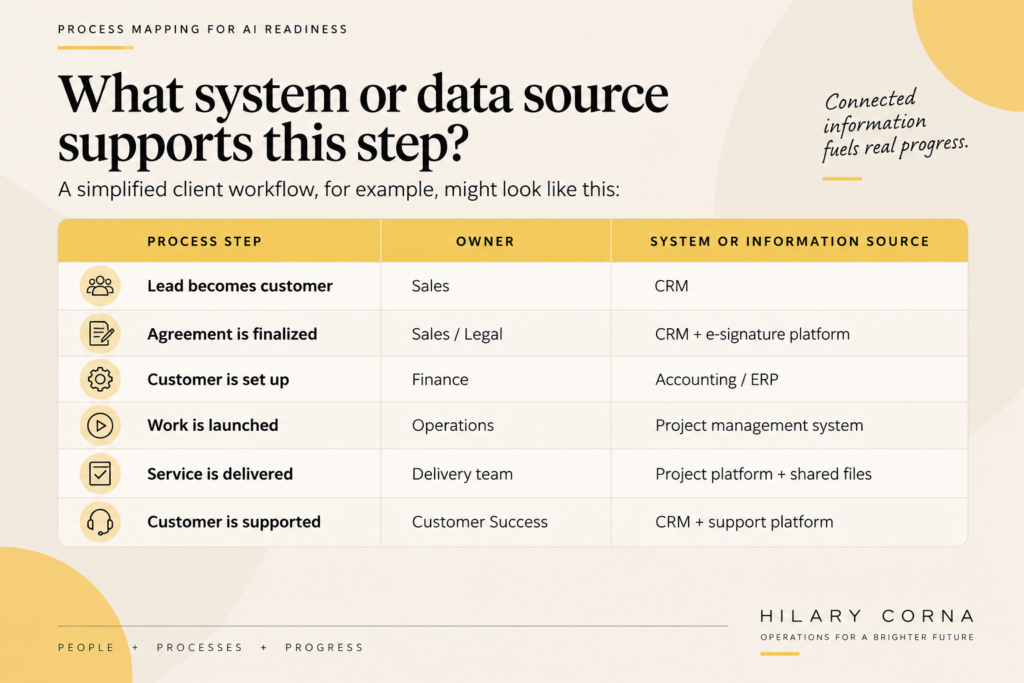
Adding that third layer changes what you can see.
Now you can identify where information originates, which system serves as the source of truth, where information moves automatically and where someone has to manually transfer it. You can see where the same data is entered twice, where context disappears and where systems simply don’t communicate.
The process map stops being only a picture of how people work. It becomes a picture of the information infrastructure supporting the work.
That matters because many operational problems don’t exist inside one department or one application. They exist in the spaces between them.
The Handoff Is Where Integration Problems Become Visible
Suppose Sales has completed everything required to close a client. From Sales’ perspective, the process worked.
Operations receives the new client. Their project management system works too.
But what happened between those two points?
Did all of the information Operations needs move with the customer? Did someone manually copy it? Did Operations have to ask Sales for clarification? Was information re-entered? Did someone search through emails or meeting notes to find context? Was a commitment made during the sales process that never reached the delivery team?
Looking only at the CRM won’t reveal that problem. Looking only at the project management platform won’t reveal it either.
You have to follow the flow across the systems.
This is why I don’t believe business systems integration should be treated purely as an IT initiative. Operations understands how work is supposed to move. IT understands how systems and data can be connected. Effective integration requires both views.
AI Raises the Stakes
This becomes even more important when AI enters the picture.
AI needs context, not simply access to more data.
If the context required to understand a customer, project, transaction or decision is fragmented across disconnected systems, AI inherits the same problem employees already experience: finding the information, determining which version is current, understanding how records relate to one another and compensating for information that was never captured in the first place.
The data suggests companies are already encountering this challenge. In MuleSoft’s 2026 research, 82% of IT leaders identified data integration as one of their biggest challenges when using AI. Even more telling, 86% agreed that without proper integration, AI agents can introduce more complexity rather than value.
Pearsall makes a similar argument in Connected Before Intelligent: AI becomes more useful when it has governed access to structured, current and traceable information across systems.
Imagine asking AI to identify why client projects are consistently delayed. The project management system might show which tasks were late, but the actual reasons may live in emails, Slack conversations, customer notes or another department’s system.
Or imagine deploying an AI agent to automate a customer handoff. If your organization hasn’t clearly established what information needs to move during that handoff, what exactly is the agent supposed to transfer?
The AI problem is actually an information-flow problem.
Rapid Technology Adoption Can Make the Problem Worse
There is another reason to address integration now: companies aren’t slowing down their technology investments while they figure this out.
IBM’s 2025 CEO Study, which surveyed 2,000 CEOs globally, found that 50% said rapid investment had resulted in disconnected technology within their organizations. At the same time, 68% identified an integrated enterprise-wide data architecture as critical for cross-functional collaboration.
That creates an important tension.
Businesses want to move faster with AI, but adding more technology can create even more fragmentation if the underlying systems aren’t designed to work together.
The answer isn’t to stop investing in technology. It’s to understand the operating environment that technology is entering.
Build the Integration Map Before the AI Roadmap
Before creating a long list of AI use cases, choose one important end-to-end workflow. It could be client onboarding, order fulfillment, quoting, project delivery, customer support, billing or hiring.
Map the workflow from beginning to end and identify who owns every step. Then add the systems and data sources supporting those steps.
At every handoff, investigate:
- What information needs to move?
- Where does that information currently live?
- Where does it need to go?
- How does it get there today?
- Is someone manually transferring or re-entering it?
- Which system is the source of truth?
- What happens when two systems disagree?
- What information never makes it into a system at all?
Don’t redesign the workflow yet. Make the current state visible first.
The article that inspired this thinking recommends a similar approach: rather than attempting a massive integration effort all at once, organizations can begin with high-friction workflows, map critical handoffs and build from there.
You may discover that two systems simply need to exchange information more effectively. You may find unnecessary duplicate entry. You may need to establish a clearer source of truth. You may discover that the technology isn’t the problem at all because the team never defined what information should move during the handoff.
And yes, you may discover an excellent opportunity for AI. But now you’ll understand why AI belongs there and what information it needs to work effectively.
AI Readiness Is Becoming an Integration Question
I’ve said before that putting AI on top of a broken process won’t fix the process. I still believe that.
But I think the conversation now needs to go one step further.
A clarified process tells you how work moves. Business systems integration helps ensure that the information required to perform that work can move with it.
That becomes part of the infrastructure for what comes next.
The companies that get the most from AI won’t necessarily be the companies with the most AI tools. They’ll be the ones that understand how their work, people, information and systems connect.
So before asking where you can add AI, map the work. Map the people. Map the systems. Then follow the information from beginning to end.
Because before your business can become more intelligent, it needs to become more connected.
Want to Work With Us?
AI can accelerate your business. But first, you need processes that are clear enough to scale.
The Ops Edge Academy is a 12-week implementation and certification program for operations leaders who want to identify what’s blocking execution, improve critical processes, and build systems that support sustainable growth.
Enrollment for the January 2027 cohort is open.